
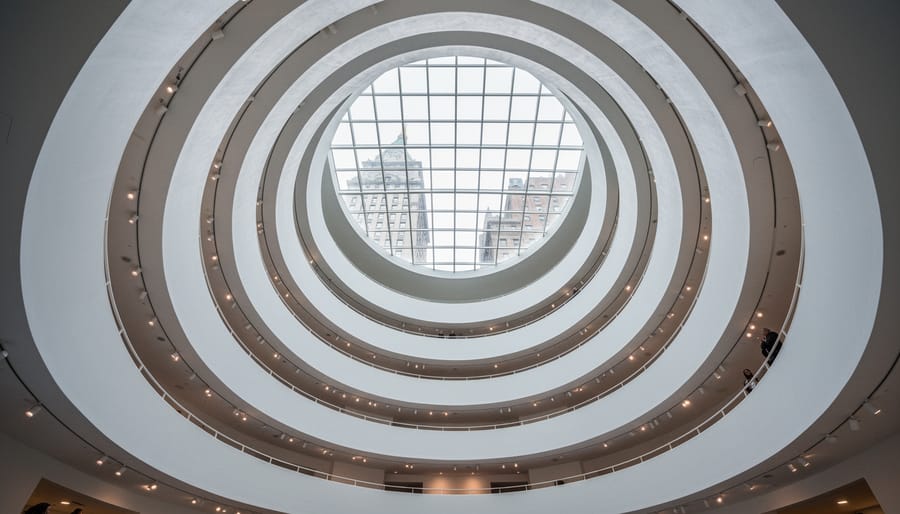
The Guggenheim Museum’s architectural style represents Frank Lloyd Wright’s most radical expression of organic modernism, embodied in a continuous spiral ramp that defies conventional museum planning and transforms how visitors experience art. Completed in 1959 on Manhattan’s Fifth Avenue, the building employs a geometry of curves rather than right angles, with its inverted ziggurat form housing a six-story helical gallery that spirals upward around a central void topped by a glass dome. This sculptural approach prioritizes spatial experience over neutral exhibition walls, creating what Wright called “one great …