
Gothic Ontario: How Medieval Spires Transformed a Canadian Landscape
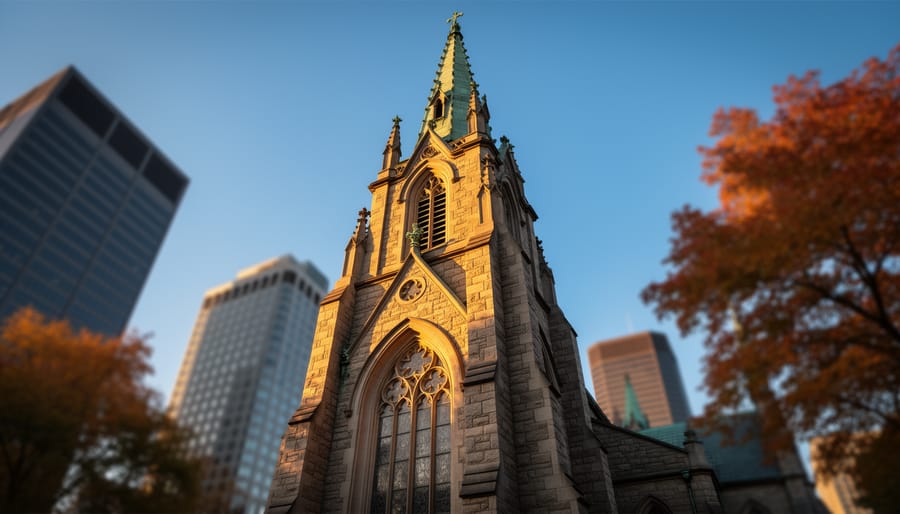
Across Ontario’s skyline, pointed arches soar toward heaven, tracery windows filter light through stone latticework, and ribbed vaults crown spaces where communities have gathered for over a century and a half. This European medieval tradition, transplanted to Canadian soil, defines much of the province’s most enduring architecture.
Gothic Revival swept through Ontario during the mid-19th century, arriving not as historical accident but as deliberate cultural statement. British colonial authorities, Anglican church leaders, and civic boosters embraced the style’s ecclesiastical associations and moral symbolism. They believed Gothic architecture represented spiritual aspiration, democratic values, and connection to English heritage. The result transformed Ontario’s built environment. From Toronto’s St. James Cathedral to Ottawa’s Parliament Buildings, Gothic structures became landmarks that still anchor their urban contexts.
The style’s persistence reveals something deeper than aesthetic preference. Ontario’s builders adapted Gothic principles to local conditions and materials. They used Credit Valley limestone, replaced European oak with Canadian pine, and modified proportions to suit North American climate and construction methods. This adaptation created a distinctively Ontario Gothic, one that respects medieval precedent while responding to regional realities.
Today, these buildings face new challenges. Heritage conservation intersects with sustainability concerns as communities work to preserve historic fabric while meeting contemporary performance standards. Retrofitting Gothic structures with modern building systems requires balancing preservation integrity against energy efficiency, a tension playing out across hundreds of sites province-wide.
Understanding Gothic Ontario means examining how architectural ideas migrate, transform, and endure across centuries and continents. These stone sentinels tell stories about identity, ambition, craftsmanship, and the ongoing negotiation between past and present that defines architectural practice.
The Gothic Revival Movement in Ontario: A Historical Context
The Gothic Revival movement swept into Ontario during the 1830s and 1840s, transforming the architectural landscape of what was then Upper Canada. This stylistic migration arrived at a pivotal moment in the province’s development, when colonial authorities and religious institutions sought to establish visible markers of cultural sophistication and imperial connection. The pointed arches, soaring spires, and intricate tracery imported from Britain became powerful symbols of permanence in a young territory still defining its architectural identity.
British colonial administrators championed the Gothic Revival as more than an aesthetic choice. They viewed it as a civilizing force, a tangible link to European heritage that would distinguish Ontario’s built environment from the practical, often austere structures of early settlement. The style carried connotations of moral rectitude and historical continuity, particularly appealing to Anglican church leaders who recognized in medieval forms an expression of spiritual authority. Churches became the primary vehicles for Gothic experimentation, their construction funded by both denominational commitment and colonial coffers eager to project stability.
The movement’s philosophical foundations drew heavily from the writings of Augustus Welby Pugin and John Ruskin, whose treatises on Gothic architecture circulated widely among educated colonists. These texts promoted the style as inherently truthful, arguing that Gothic buildings honestly expressed their structural systems rather than concealing them behind classical façades. This notion of architectural morality resonated with Victorian sensibilities about authenticity and craftsmanship.
Ontario’s embrace of Gothic Revival paralleled broader developments in Victorian architecture in Ontarioyet distinguished itself through specific programmatic applications. Educational institutions, particularly those affiliated with religious denominations, adopted Gothic forms to signal academic seriousness and institutional longevity. Government buildings followed suit, though more cautiously, often blending Gothic elements with classical symmetry.
The movement’s success in Ontario reflects how transplanted architectural traditions can take root when they align with cultural aspirations. By the 1850s, Gothic Revival had evolved from imported novelty to established convention, fundamentally shaping how Ontarians conceived of institutional architecture. The style’s association with permanence and moral authority made it particularly suitable for a society building infrastructure intended to last generations, establishing an architectural legacy that continues to define the province’s historic districts today.
Defining Features: Ontario’s Interpretation of Gothic Elements
Material Adaptations: Limestone, Brick, and Local Stone
Ontario’s abundant geological resources fundamentally shaped how Gothic architecture took root in the province. The readily available limestone quarries around Kingston, Toronto, and along the Niagara Escarpment provided builders with material that was both structurally sound and visually distinctive. Unlike the grey stones common in European Gothic cathedrals, Ontario’s limestone heritage introduced warm, honey-colored and cream-toned facades that gave local Gothic buildings an unexpected luminosity.
This material adaptation created more than aesthetic differentiation. Limestone’s workability allowed craftsmen to execute the intricate tracery, pointed arches, and carved ornamentation that define Gothic design, while its durability ensured these structures would withstand Ontario’s harsh seasonal extremes. The stone’s thermal mass also provided practical benefits, moderating interior temperatures in an era before modern climate control systems.
Regional variations emerged based on local geology. Buildings in the Kingston area often display a bluish-grey limestone, while structures farther west incorporate warmer buff-toned stone. Some architects combined materials, integrating red Credit Valley sandstone or local brick with limestone trim to create polychromatic effects that departed from traditional Gothic monochromy.
This resourceful use of indigenous materials reflects an early, perhaps unintentional, form of sustainable practice. Minimal transportation reduced both construction costs and environmental impact. The result is a Gothic architectural tradition that honors European precedent while asserting a distinctly Canadian identity, proving that regional materials can transform imported styles into something authentically local.
Climate Considerations in Gothic Design
Ontario’s unforgiving winters presented Gothic revivalists with challenges their European predecessors never imagined. Where medieval England contended with rain, nineteenth-century Ontario architects confronted snowfall measured in meters and temperatures plunging below minus thirty Celsius. These climate extremes demanded thoughtful reinterpretation of Gothic principles.
Roof pitch became a critical consideration. Ontario’s Gothic structures feature notably steeper rooflines than their British counterparts, sometimes approaching 60-degree angles to facilitate rapid snow shedding. The iconic spires and pinnacles that define the style required structural reinforcement to withstand ice accumulation and freeze-thaw cycles that could fracture traditional limestone through repeated expansion and contraction.
Drainage systems underwent substantial modification. Gothic architecture traditionally relies on gargoyles and open drainage channels, but Ontario’s freeze conditions rendered these impractical. Architects developed concealed downspouts and integrated heating elements in gutters for significant buildings. The seasonal threat of ice dams necessitated additional layers of waterproofing beneath slate and tile roofs, invisible innovations that preserved exterior aesthetics while addressing practical realities.
Material selection evolved accordingly. Local limestone proved more frost-resistant than imported stone, while Credit Valley sandstone offered superior durability in harsh conditions. Window tracery required thicker mullions to prevent warping from temperature differentials between heated interiors and frigid exteriors.
These adaptations represent sustainable design thinking before the term existed. Ontario’s Gothic builders didn’t simply transplant European forms. They created a regionally appropriate architecture that honored historical precedent while responding intelligently to environmental constraints, proving that successful design always emerges from place-specific problem-solving.
Landmark Gothic Structures Shaping Ontario’s Identity
Parliament Hill: Gothic Grandeur as National Symbol
Standing above the Ottawa River, the Centre Block represents more than the seat of Canadian democracy. It embodies a deliberate choice to root national identity in Gothic Revival’s vertical aspirations and medieval symbolism. When fire destroyed the original building in 1916, reconstruction offered an opportunity to reimagine federal architecture. Instead, the commitment to Gothic deepened.
The rebuilt Centre Block, completed in 1927, amplified the Gothic language through its soaring Peace Tower, pointed arches, and intricate stone tracery. Architects John A. Pearson and Jean-Omer Marchand understood that Parliament Hill’s architectural history required continuity with the 1860s vision of Fuller and Jones, yet they introduced refinement and sophistication that elevated the style beyond mere imitation of Westminster.
The Library of Parliament, which survived the 1916 fire, remains the complex’s architectural jewel. Its sixteen-sided polygon, flying buttresses, and carved white pine interiors create a sanctuary of knowledge wrapped in Gothic splendor. The reading room’s ribbed vaulting draws the eye heavenward, reinforcing connections between enlightenment and aspiration inherent to the style.
This architectural decision established Gothic as Canada’s official design vocabulary for governance. From provincial legislatures to countless municipal buildings across Ontario, the Gothic precedent set on Parliament Hill rippled outward. The choice positioned Canada apart from the neoclassical preferences dominating American civic architecture, creating a distinctly northern identity rooted in European medieval tradition yet adapted to a modern democratic nation.

University College and Academic Gothic
The Collegiate Gothic tradition found its most profound expression in Ontario at the University of Toronto, where towering stone facades and intricate tracery transformed higher education into a visual declaration of scholarly gravitas. Beginning in the 1850s with University College, architects deliberately evoked Oxford and Cambridge to establish institutional legitimacy in a young colonial society. The building’s Romanesque-Gothic hybrid, designed by Frederick William Cumberland, featured dramatic pointed arches and elaborately carved stonework that announced the university’s aspirations toward Old World academic prestige.
This architectural language proliferated across Ontario’s educational landscape throughout the early twentieth century. Hart House at U of T, completed in 1919, perfected the style with vaulted great halls and stone cloister walks that created contemplative spaces for intellectual discourse. Victoria College’s Emmanuel College and Knox College followed suit, each contributing Gothic Revival spires to the university’s distinctive skyline.
The choice wasn’t merely aesthetic. Gothic architecture embodied permanence and continuity, connecting Canadian students to centuries of scholarly tradition. Queen’s University in Kingston and Western University in London adopted similar vocabularies, recognizing how these stone monuments could convey institutional authority and educational excellence. The legacy endures today, with contemporary campus additions often incorporating Gothic elements to maintain architectural harmony while integrating modern sustainability practices and flexible learning environments.
Sacred Spaces: Churches and Cathedrals
Ontario’s Gothic Revival churches represent some of the province’s most spiritually and architecturally significant structures, translating centuries of European ecclesiastical tradition into the Canadian landscape. St. James Cathedral in Toronto stands as the definitive example, its soaring spire dominating the downtown skyline since 1874. The cathedral’s verticality draws the eye heavenward through pointed arch windows and intricate stone tracery, while flying buttresses provide both structural support and visual drama.
Beyond Toronto, Ontario’s historic churches demonstrate how communities across the province embraced Gothic forms to express religious devotion and civic pride. St. Andrew’s Presbyterian Church in Ottawa features exceptional stonework and ribbed vaulting, while Kingston’s St. George’s Cathedral employs local limestone to create a distinctly regional interpretation of English Gothic precedents.
These sacred spaces achieved remarkable sustainability through careful material selection and passive climate control. Thick masonry walls provided thermal mass, while high ceilings and strategic window placement facilitated natural ventilation. The enduring presence of these structures across Ontario’s communities illustrates how spiritual architecture transcended mere aesthetics, creating gathering places that anchored social and cultural life while inspiring generations through carefully crafted light, proportion, and sacred geometry.
Gothic Architecture’s Impact on Urban and Rural Landscapes
Gothic architecture fundamentally transformed Ontario’s visual landscape during the 19th and early 20th centuries, establishing a distinctive architectural vocabulary that separated ecclesiastical and civic institutions from their surroundings. The vertical emphasis inherent to Gothic design created powerful landmarks that oriented communities spatially and socially, positioning churches, universities, and government buildings as unmistakable centers of authority and gathering.
In cities like Toronto, Kingston, and Ottawa, Gothic spires punctuated skylines with dramatic effect. St. James’ Cathedral’s soaring tower dominated Toronto’s eastern core, visible from the harbor and surrounding streets, while the Parliament Buildings’ Gothic Revival silhouette became synonymous with national identity. These structures didn’t simply occupy space; they commanded it, establishing architectural hierarchies that reflected the social order of colonial and early confederation society.
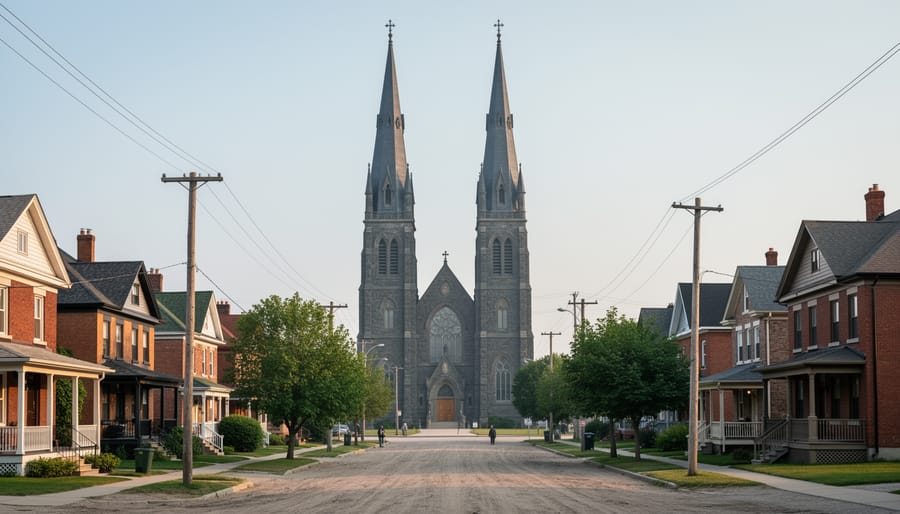
This principle proved equally powerful in rural contexts, where a Gothic church spire rising above farmland served as both navigational landmark and community anchor. The visual dominance of these structures reinforced their social significance, drawing rural populations toward centralized worship and civic participation.
The material palette of Ontario Gothic buildings further enhanced their landscape impact. Local limestone in Kingston and Credit Valley sandstone near Toronto created warm, tactile surfaces that distinguished institutional architecture from the wood-frame construction dominating residential areas. This material differentiation reinforced class and purpose distinctions within communities while contributing to a sense of permanence and gravitas.
Small towns throughout southern Ontario adopted simplified Gothic forms for their churches and occasional civic buildings, creating recognizable patterns across the countryside. The repetition of pointed arches, buttresses, and modest bell towers established visual continuity between communities while allowing for regional variation based on available resources and builder expertise. From a sustainability perspective, many of these structures utilized locally quarried stone and timber, reducing transportation impacts while supporting regional economies and creating buildings remarkably well-suited to Ontario’s climate conditions.
The cumulative effect was a landscape where Gothic forms signaled institutional importance and community identity, creating architectural legibility that persists today. These buildings continue to anchor neighborhoods and define community character, demonstrating how a medieval European architectural language became integral to Ontario’s built environment and collective memory.
The Sustainability Legacy of Gothic Design Principles
Ontario’s Gothic structures offer an unexpected lesson in environmental stewardship that predates modern sustainability by centuries. The thick stone walls characteristic of these buildings function as exceptional thermal regulators, absorbing heat during warm periods and releasing it gradually when temperatures drop. This passive climate control mechanism reduces energy consumption in ways that contemporary green building standards actively pursue. Churches like St. James Cathedral in Toronto demonstrate this principle in action, their masonry construction maintaining relatively stable interior temperatures throughout Ontario’s extreme seasonal variations.
The expansive window systems that define Gothic architecture serve dual purposes that align perfectly with current energy-efficient design thinking. These openings maximize natural daylight penetration, dramatically reducing artificial lighting requirements during daytime hours. The original designers couldn’t have anticipated LEED certification criteria, yet their emphasis on vertical windows and clerestory arrangements addresses daylighting strategies that architects now calculate with sophisticated software. The result? Buildings that have operated with minimal lighting energy for over a century.
Longevity represents perhaps the most compelling sustainability argument for Gothic construction methods. These buildings weren’t designed for 50-year lifespans followed by demolition and landfill waste. The craftsmanship and material quality inherent in Gothic architecture created structures meant to serve communities across generations. Many Ontario Gothic buildings approaching their 150th or 200th anniversaries continue functioning as intended, avoiding the resource consumption and carbon emissions associated with new construction.
The embodied energy already invested in these heritage structures makes their preservation a sustainability imperative. Adaptive reuse projects throughout the province demonstrate how Gothic buildings accommodate contemporary functions without wholesale reconstruction. Stone, timber, and iron components that formed these structures can endure indefinitely with proper maintenance, offering a counterpoint to disposable modern construction practices. From a global perspective, Ontario’s commitment to maintaining its Gothic architectural heritage provides a practical model for sustainable urban development that values preservation over replacement.
Contemporary Echoes: Gothic Influence on Modern Ontario Architecture
Ontario’s architectural landscape reveals an intriguing conversation between Gothic heritage and contemporary innovation. Modern practices increasingly reference the soaring verticality and structural honesty that defined Gothic cathedrals, reimagining these medieval principles through glass, steel, and sustainable materials.
The Thomas Fisher Rare Book Library at the University of Toronto exemplifies this translation. Completed in 1973, its precast concrete façade features deep vertical recesses that echo Gothic fenestration patterns while protecting precious manuscripts from light damage. The building’s structural system becomes ornamental, continuing the Gothic tradition of expressing load-bearing elements as design features.
Toronto’s Metropolitan United Church expansion, completed in 2019, demonstrates how pointed arch motifs adapt to contemporary worship spaces. The addition uses laminated timber arches that reference Gothic vaulting while achieving superior carbon sequestration compared to conventional materials. This sustainable reinterpretation addresses both heritage sensitivity and climate responsibility.
Residential projects also draw from Gothic vocabulary. Several Cabbagetown rowhouse renovations incorporate steeply pitched rooflines and elongated windows that reference nearby Victorian Gothic neighbors while introducing passive solar orientation and triple-glazed assemblies. The verticality serves both aesthetic continuity and functional performance.
Globally, this Ontario approach aligns with international practices reimagining historical styles through environmental lenses. Copenhagen’s Blox building and London’s NEO Bankside reference Gothic proportions while prioritizing energy efficiency. Ontario architects participate in this worldwide dialogue, contributing regional interpretations that respond to provincial climate conditions and material availability.
The tension between preservation and innovation proves particularly productive in university settings. Queen’s University’s new student center incorporates limestone sourced from the same quarries that supplied original campus Gothic buildings, maintaining material continuity while employing contemporary structural engineering that increases clear spans and reduces embodied carbon through optimized thickness.
This architectural evolution honors Gothic Ontario’s historical significance without resorting to pastiche. By abstracting essential principles rather than copying superficial details, contemporary designers create buildings that acknowledge their lineage while advancing sustainability imperatives and spatial innovation.
Preservation Challenges and Adaptive Reuse
Ontario’s Gothic heritage faces an increasingly complex preservation landscape. Century-old masonry, deteriorating stonework, and evolving building codes present formidable obstacles for conservationists working to maintain these architectural treasures. The province’s harsh climate cycles accelerate material degradation, particularly affecting the limestone and sandstone favored in 19th-century construction. Water infiltration, freeze-thaw damage, and acid rain have compromised countless structures, requiring sophisticated intervention strategies.
Heritage building restoration projects across Ontario demonstrate both the challenges and possibilities inherent in preserving Gothic architecture. Financial constraints remain the primary barrier. Specialized craftspeople capable of replicating historical stonecarving and tracery work command premium rates, while sourcing period-appropriate materials often requires importing from distant quarries. Many smaller communities struggle to fund necessary interventions for their Gothic landmarks, leading to incremental deterioration.
| Building | Original Use | Current Use | Preservation Approach |
|---|---|---|---|
| Knox Presbyterian Church, Guelph | Congregation worship | Mixed-use cultural venue | Retained worship space with added community programming |
| St. Andrew’s Church, Toronto | Anglican parish | Performance hall and offices | Interior reconfiguration preserving exterior Gothic elements |
| Old Victoria Hospital, London | Medical facility | Residential condominiums | Façade retention with contemporary interior insertions |
| Gore’s Landing School | Educational institution | Community arts center | Sympathetic additions using compatible materials |
These adaptive reuse projects illustrate innovative approaches to sustainability through preservation. Converting Gothic structures for contemporary functions reduces embodied carbon compared to demolition and new construction. Successful interventions balance respect for original craftsmanship with necessary modern systems integration. Climate control, accessibility upgrades, and life-safety installations require careful design to avoid compromising character-defining elements like pointed arch windows and ribbed vaulting.
The conversation around Gothic preservation increasingly incorporates global best practices. Techniques developed for European cathedral restoration inform Ontario projects, while digital documentation technologies enable precise condition assessments and restoration planning. Laser scanning and photogrammetry create detailed records, safeguarding architectural knowledge even when physical intervention proves economically unfeasible. This international exchange of expertise strengthens provincial conservation capacity while honoring the transnational origins of Gothic architecture itself.
Gothic architecture’s transformation of Ontario’s built environment represents one of the most significant cultural imports in Canadian history. From the limestone spires of Parliament Hill to the modest brick churches dotting rural crossroads, the Gothic Revival didn’t merely arrive in Ontario; it became Ontario. This medieval vocabulary, reimagined through 19th-century ambitions and adapted to local materials and climate, created an architectural language that still speaks to how the province sees itself.
The movement’s success lay partly in its adaptability. Grand institutional buildings like University College and Osgoode Hall demonstrated Gothic’s capacity for monumentality and scholarly gravitas. Parish churches from Kingston to Thunder Bay proved the style could serve humble congregations with equal dignity. This democratic reach, spanning economic and geographic divides, embedded Gothic forms into the collective consciousness in ways more exclusive architectural movements never achieved.
Today, these structures continue shaping how residents and visitors experience Ontario’s cities and towns. The verticality, the play of light through stained glass, the textured stonework weathered by decades of freeze-thaw cycles create sensory experiences that digital renderings can’t replicate. Conservation efforts increasingly recognize this heritage as irreplaceable, not simply for historical value but for the spatial richness these buildings contribute to contemporary urban life.
The Gothic legacy challenges current practitioners to consider how architecture serves culture beyond mere function. As sustainability becomes paramount, these century-old buildings demonstrate material durability and adaptive reuse potential that many modern structures lack. Ontario’s Gothic inheritance reminds us that truly transformative architecture transcends stylistic trends to become inseparable from place itself.

Related Posts
Architectural Details That Define a Classic Fireplace

Cash House Buyers Transform Britain’s Derelict Buildings Into Architectural Gems

Why Calgary’s Historic Buildings Need Specialized Architectural Painting

How Delta-8 Retail Spaces Are Redefining Cannabis Store Design

Tips for Designing a Vape-Friendly Building to Enhance Overall Comfort and Safety

Four Architecturally Significant Museums Designed by Renowned Studios
Architectural Marvels in Canadian Cities

10 Best Architectural Museums Worldwide, Reviewed

Art Gallery of Ontario Expansion News Update: What Changed and What to Watch in 2026
How Badlands Houses Transform Ontario’s Harshest Terrain Into Architectural Masterpieces

The Badlands of Ontario: Where Raw Landscape Meets Remarkable Architecture